Polaritonics

Surface phonon-polaritons (SPhPs) are hybrid electromagnetic modes that form on the surfaces of polar dielectric materials through the coupling of photons and optical phonons. Unlike thermal phonons, which scatter frequently in thin films and lose energy over nanometer-scale distances, SPhPs can propagate coherently over distances of hundreds of micrometers and remain active well above room temperature. This makes them a promising heat carrier for thermal management in microelectronics and nanophotonics, and a means of achieving super-Planckian radiative heat transfer. In this project, we investigate thermal transport via SPhPs experimentally and theoretically, using the SCUFF-EM fluctuational electrodynamics framework alongside thermal transport measurements.
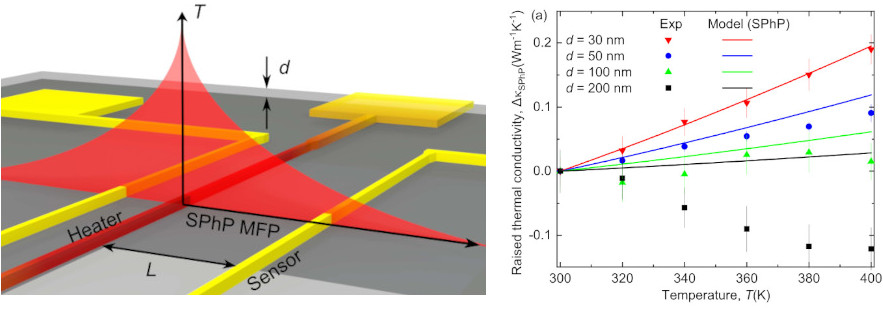
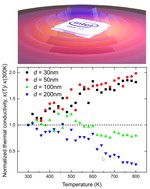
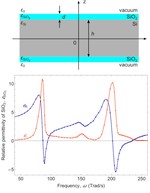
Our first line of work focuses on in-plane heat conduction via SPhPs in suspended nanomembranes. We experimentally demonstrated that SPhPs form on SiN nanomembranes thinner than 50 nm and cause the in-plane thermal conductivity to double as temperature rises from 300 to 800 K — direct evidence that SPhPs open an additional heat conduction channel beyond phonons. We further showed that this SPhP-mediated transport is quasi-ballistic over distances exceeding hundreds of micrometers, far beyond the mean free path of thermal phonons. Complementary theoretical work revealed how SPhPs in SiO₂ nanolayers couple with guided modes in adjacent Si layers, providing design rules for engineering SPhP thermal conduction in Si/SiO₂ multilayer systems.
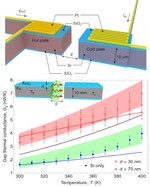
A second line of work addresses far-field and near-field thermal radiation between polar and metallic nanostructures. We experimentally demonstrated that coating Si microplates with thin SiO₂ layers creates polaritonic waveguides that double the far-field thermal radiative conductance between the plates. Theoretical studies revealed a dimensional crossover in far-field thermal radiation between subwavelength gold membranes, transitioning from three-dimensional to two-dimensional heat transfer as membrane thickness decreases to the nanoscale. For polar SiC membranes, we showed that far-field thermal conductance can exceed the blackbody limit by over 460 times due to the interplay of two surface polariton resonances, and that near-field radiation is further amplified by electromagnetic modes localized at the corners and edges of the membranes.
Publications
Near-field thermal radiation between deep subwavelength membranes driven by corner and edge modes
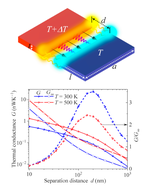
Far-field heat transfer maximization through controlled polariton coupling between deep-subwavelength polar membranes
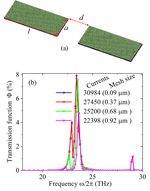
Enhanced Far-Field Thermal Radiation through a Polaritonic Waveguide
In-plane surface phonon-polariton thermal conduction in dielectric multilayer systems
Observation of heat transport mediated by the propagation distance of surface phonon-polaritons over hundreds of micrometers
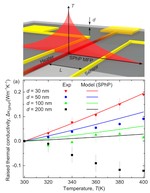
Enhanced thermal conduction by surface phonon-polaritons