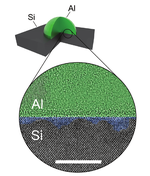
Wave phononics

Phononic crystals are periodic nanostructures designed to engineer the phonon dispersion relation and control heat conduction using the wave properties of phonons. Our early theoretical work predicted that periodic arrays of holes or pillars in silicon membranes can coherently modify phonon dispersion, leading to reductions in thermal conductance — and, counterintuitively, a thermal conductance “boost” effect where a patterned membrane conducts heat better than an unpatterned one due to constructive phonon interference. We tested these predictions experimentally, measuring thermal conductance in hole-based and pillar-based phononic crystals at low temperatures, and verifying the coherent regime by observing differences in thermal conductivity between ordered and disordered lattices that disappear above a characteristic temperature. We also established that the neck — the minimum dimension between adjacent holes — is the dominant geometric parameter controlling thermal conductivity reduction, rather than the periodicity itself.
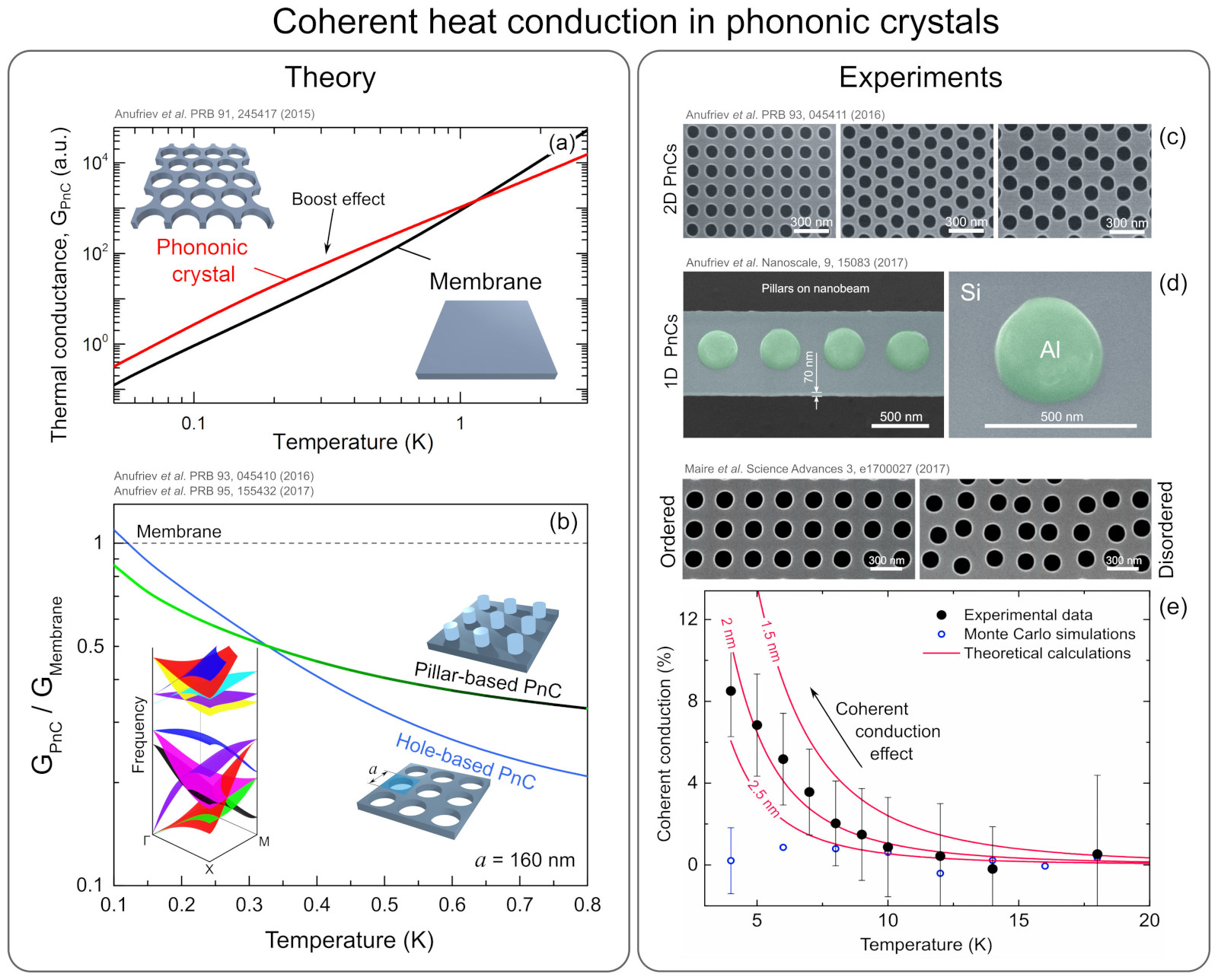
The figure above summarizes our research on coherent thermal transport. Panel (a) shows the thermal conductance boost effect when a phononic crystal becomes more conductive than a membrane without holes due to phonon interference. Panel (b) shows tuning of thermal conductance via structure periodicity in various phononic crystals at low temperatures. Experiments on (c) hole-based phononic crystals of different lattices, (d) pillar-based phononic crystals, and (e) phononic crystals with ordered and disordered lattices. At low temperatures, the difference between ordered and disordered lattices indicates the coherent regime.
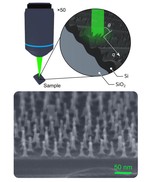
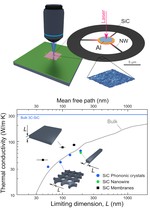
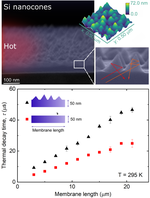
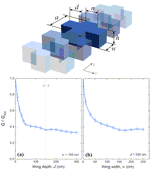
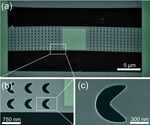
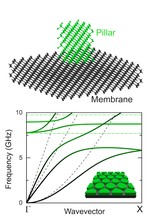
Beyond simple hole arrays, we investigated a broad range of nanostructure geometries: silicon fishbone nanowires, nanowires with periodic wings, phononic crystals with asymmetric holes, silicon membranes with surface nanocones, and membranes coated with nanopillars of different sizes. In the nanopillar case, we disentangled coherent (wave interference) and incoherent (boundary scattering) contributions to thermal conductivity reduction across the 4–300 K range. We also extended the study to silicon carbide, systematically mapping the nanoscale limit of thermal conductivity across SiC membranes, nanowires, and phononic crystals. The results of this decade of work are summarized in two review articles covering one-dimensional and two-dimensional phononic crystals.
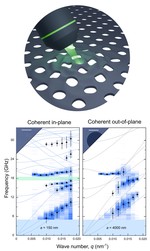
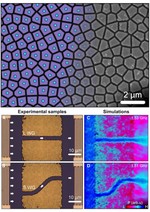
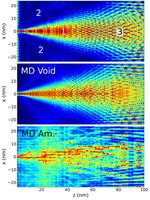
Most recently, the project has entered a new phase combining inverse design with direct phonon dispersion measurements via Brillouin light scattering spectroscopy. Using a genetic algorithm, we designed a nanophononic metasurface with a highly anisotropic dispersion — confirmed experimentally — demonstrating that phononic crystals can now be engineered beyond geometries accessible to human intuition. We experimentally identified the spectral and spatial limits at which phonon interference breaks down in two-dimensional phononic crystals, revealing a gradual crossover through an intermediate regime dominated by out-of-plane interference as crystal dimensions shrink to the nanoscale. We also demonstrated hypersonic acoustic wave control using stealthy hyperuniform nanostructures, where a disordered-yet-correlated arrangement of gold nanopillars suppresses surface acoustic wave transmission across a broad frequency range while still supporting efficient waveguiding.
Publications
When phononic crystals fail: Spatial and spectral limits of phonon interference
Hypersonic acoustic wave control via stealthy hyperuniform phononic nanostructures
Phonon dispersion of nanoscale honeycomb phononic crystal: gigahertz and terahertz spectroscopy comparison
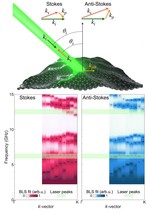
Tailoring phonon dispersion of a genetically designed nanophononic metasurface
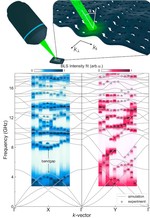
Phonon diffraction and interference using nanometric features
Impact of nanopillars on phonon dispersion and thermal conductivity of silicon membranes
Nanoscale limit of the thermal conductivity in crystalline silicon carbide membranes, nanowires, and phononic crystals
Review of thermal transport in phononic crystals
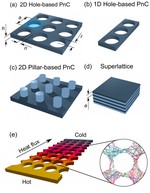
Review of coherent phonon and heat transport control in one-dimensional phononic crystals at nanoscale
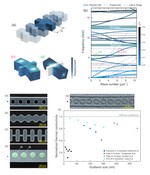
Coherent and incoherent impacts of nanopillars on the thermal conductivity in silicon nanomembranes
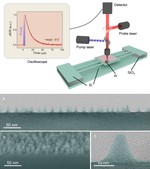
Thermal conductivity reduction in a silicon thin film with nanocones
Coherent thermal conduction in silicon nanowires with periodic wings
On the reduction and rectification of thermal conduction using phononic crystals with pacman-shaped holes
Phonon and heat transport control using pillar-based phononic crystals
Thermal conductivity reduction in silicon fishbone nanowires
Aluminium nanopillars reduce thermal conductivity of silicon nanobeams