Ballistic heat
 Simulation of ballistic phonon flights
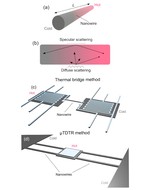
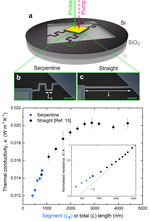
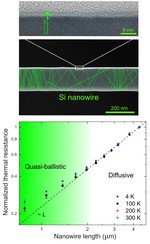
In this project we study quasi-ballistic heat conduction in semiconductor nanowires and nanostructures. In the ballistic regime, phonons travel without scattering and carry thermal energy more efficiently than in the conventional diffusive regime. Our work in silicon nanowires established the length and temperature scales of this phenomenon: thermal resistance measurements on nanowires of different lengths revealed non-linear length dependence, a hallmark of quasi-ballistic conduction driven by Lévy phonon flights. By comparing straight and serpentine nanowires, we isolated the ballistic contribution and showed that it is strongest in short nanowires at low temperatures, reaching distances of 400–800 nm at 4 K, and gradually disappearing as length or temperature is increased.

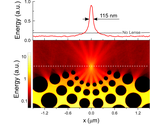
The figure above summarizes our results showing ballistic heat conduction. (a) Thermal resistance measured on straight Si nanowires shows that the values deviate from linear dependence typical for diffusive transport, which indicates the presence of ballistic thermal transport. (b) Thermal conductivity measured on straight nanowires is higher than that measured on serpentine nanowires, but this difference disappears above 200 K, which shows the range in which ballistic heat conduction occurs. (c) The heat focusing effect based on the ballistic thermal transport. Experimental results agree with Monte Carlo simulations.
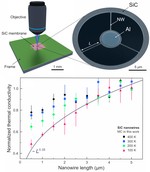
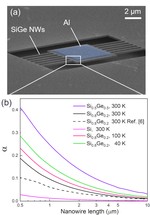
Building on the nanowire results, we demonstrated that ballistic phonon transport can be harnessed to guide and focus heat in phononic nanostructures: arrays of holes in silicon membranes direct ballistic phonons along specific paths, enabling heat focusing effects analogous to ray optics. We also extended our studies to other semiconductor materials — in SiGe polycrystalline nanowires, alloying reduces ballistic transport compared to pure silicon, while in SiC nanowires we identified quasi-ballistic conduction at length and temperature scales relevant to microelectronics. These results are summarized in a Perspective review article covering ballistic heat conduction across different nanowire systems.
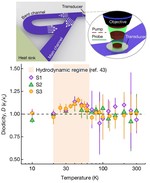
Most recently, the project expanded into the related regime of hydrodynamic phonon transport, where collective phonon-phonon interactions lead to viscous heat flow rather than individual phonon flights. We demonstrated heat rectification in micrometre-scale graphite Tesla valves, where the asymmetric geometry causes heat to conduct more easily in one direction than the other. This thermal diode effect, observed at 45 K and reported in Nature, is driven by hydrodynamic phonon transport — a phenomenon that bridges the ballistic and diffusive regimes and opens new possibilities for controlling heat flow in quantum technologies and cryogenic devices.
Publications
A graphite thermal Tesla valve driven by hydrodynamic phonon transport
Quasi-ballistic thermal transport in silicon carbide nanowires
Ballistic heat conduction in semiconductor nanowires
Semiballistic thermal conduction in polycrystalline SiGe nanowires
Probing ballistic thermal conduction in segmented silicon nanowires
Quasi-ballistic heat conduction due to Lévy phonon flights in silicon nanowires
Heat guiding and focusing using ballistic phonon transport in phononic nanostructures